


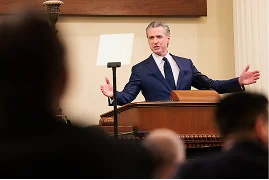
Newsom unloads on California wealth tax proposal: ‘Makes no sense’
Politico •

Watch:
Professor Zucman on the Prop 40 “experiment” being conducted on California
Professor Zucman interview with The Economist. May 2026
Watch:
Professor Behind CA Wealth Tax Admits It’s an “Experiment,” and unlikely to be a one-time tax
Professor Saez, Stanford Institute for Economic Policy Research Economic Summit. March 2026
Although officially billed as a “one-time” tax, the French economists who co-authored Prop 40 admit that it is unlikely to remain one. The measure would be the first net wealth tax in modern U.S. history, and the academics behind it have repeatedly said that Prop 40 is an “experiment” that is likely to be expanded.
So the thinking is that this five-year experiment is going to determine: Is it a success, like I believe, or is it a disaster…. We’ll see and that’s gonna condition whether this tax is gonna be a one-time experiment or it’s gonna be permanent, if it’s deemed to be a successful fundraiser.”
— Professor Saez, Sieper Economic Summit at Stanford University · March 2026(March 2026)
"California could absolutely implement an annual wealth tax," said Zucman, who’s also a professor at the Paris School of Economics in his native France. "This one-time tax is just the starting point of what could be."”
— Professor Zucman, interview in Capital + Main · July 2026(July 2026)
Many economists warn that Prop 40, by its very nature, will lead to other taxes. Because it will drive wealthy taxpayers—who now pay nearly half of the state’s income taxes—out of California, it will lead to permanent state revenue loss and widespread economic impacts.
And when the money runs out from a crumbling tax base, there’s no plan to ensure politicians won’t be back with a different tax on someone else. That may be why Prop 40 includes a loophole that changes the state Constitution to allow lawmakers to tax anyone’s personal wealth.
It’s simple math: If wealthy individuals, investment, employers, and capital leave California, the state collects less revenue to support schools, healthcare, housing, wildfire response, infrastructure, public safety, and more. Prop 40 will drastically reduce long-term state budget revenue, and taxes will have to be expanded or created to make up the difference. That someone may be you:
Stanford economists estimate Prop 40 will end up costing the state nearly $25 billion due to wealth flight, economic impacts, and the permanent loss of tax revenue.
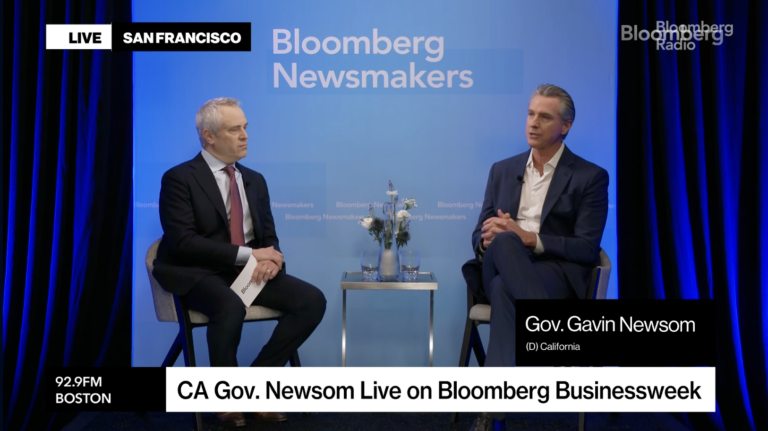
In a Bloomberg Businessweek interview, Governor Gavin Newsom, who opposes Prop 40, argues that the tax would ultimately backfire on the very services it’s meant to fund: “The fact is it actually will reduce investments in education. It will reduce investments in teachers and librarians, childcare. It will reduce investments in firefighting and police.”
“A one-time tax would not solve the state’s structural fiscal problems even if it managed to raise significant revenues.”—Andersen Institute, Columbia, and UC Berkeley academic research paper
Prop 40 contains a loophole that gives the Legislature the ability to amend its provisions without a vote of the people. This means lawmakers could expand the tax beyond billionaires to additional assets and taxpayers.
“It would introduce radical complexity, guarantee legal chaos, and virtually assure an exodus of high-wealth residents if enacted—all for the sake of one-time revenue that fails to address the problems California faces.”—former director of California’s Department of Finance & chief economic and business adviser to Governor Gavin Newsom on Prop 40
Why would anybody believe that it’s a one-time tax? The measure has to write its wealth tax authorization into the California Constitution. It’s written in a way that’s specific to this measure, but once that infrastructure is in place, future wealth taxes can be built on top of it, at any rate, at any threshold, and at any time.”
— Stanford Professor Joshua Rauh, SIEPR Economic Summit at Stanford University · March 2026(March 2026)
Politico •

The Wall Street Journal •

Tax Notes •
Hoover Institution •
Wall Street Journal •

Andersen Institute •

KQED •
Bloomberg •